
Onondaga County City Directory Runs
Syracuse is the key place to search when an Onondaga County name or address is historical. No one repository supplies every year, so a sound search begins by matching the needed date to the right shelf, reel, fiche, or catalog. The County Clerk Archives, Onondaga County Public Library, and New York State Library preserve overlapping but not identical runs. A gap in one collection is a reason to try the others, not a conclusion that a household was absent.
| Collection | Years | Where Held | Access Coverage |
|---|---|---|---|
| County Clerk Archives Syracuse directories and census | Directories 1861-present; census 1850-1925 | Onondaga County Clerk Archives | Archive holdings; older material may be on Photostat or microfilm |
| OCPL Syracuse and suburban directories | Print 1936-present; microfilm 1862-1935; fiche 1844-1862 | OCPL Local History & Genealogy | In-person local-history collection |
| OCPL telephone directories | 1894-present | OCPL Local History & Genealogy | In-person companion source |
| New York State Library Syracuse holdings | Fiche: 1844, 1851/52, 1853-55/56, 1857-59/60; film: 1861-1935 | New York State Library | State-library city-directory holdings |
| Boyd's Syracuse Directory | 1894-1895 | FamilySearch catalog | Digital viewing may require an account, affiliate access, or permission |
These volumes are annual snapshots. The useful date is the volume year and page, not merely the search date. Keep the repository, title, and format with every transcription.
Syracuse City Directory Runs at OCPL
OCPL Local History & Genealogy at 447 South Salina Street holds the principal local run. The research collection is on the third floor, and its published hours are Monday, Thursday, Friday, and Saturday from 9:00 to 4:45; Tuesday and Wednesday from 9:00 to 7:15; Sunday closed. An OCPL card is required, and nonresidents can ask the Welcome Desk about obtaining one. The staff may search these volumes and other sources on request when given name variants, approximate dates, street or municipality, occupation, and a focused question. That reference help is not a promise of a complete search.
The OCPL collection page introduces the local-history shelves and access point.
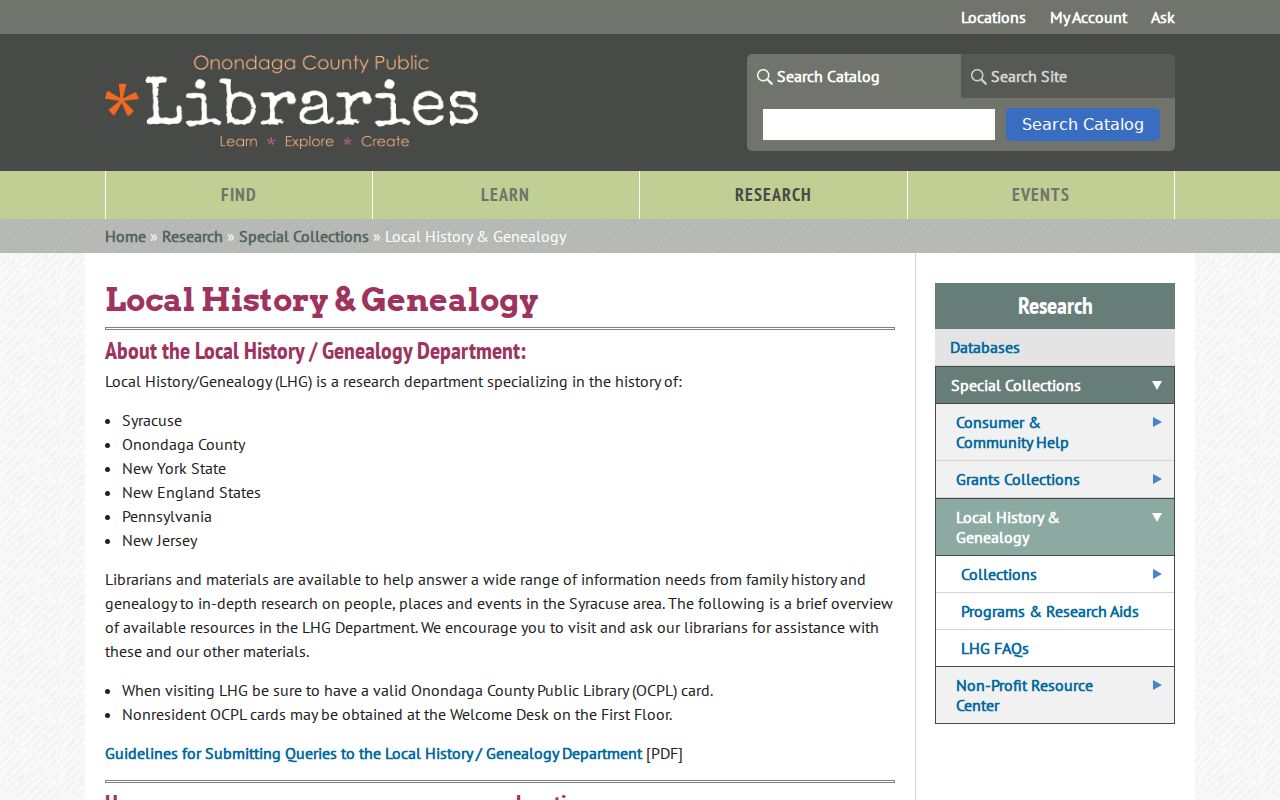
Use the print, microfilm, fiche, and telephone-book runs as separate formats in the same city-directory search, then cite the one that produced the entry.
OCPL also has Syracuse newspapers on microfilm from 1850 to within three months of the present, plus cemetery cards, WPA files, and family files. A move, marriage, death, or business opening can provide a date window for checking neighboring directory years.
Note: Ask staff about the requested volume and any format restrictions before planning a long visit.
Onondaga County Directories at Clerk Archives
The County Clerk Archives supplies another route when a Syracuse directory date falls before the later OCPL print run or when a directory needs census context. Its holdings include Syracuse directories from 1861 to the present and census material from 1850 through 1925. The Archives also lists naturalization material from 1808 onward, Syracuse marriage records for 1908-1938, military material, maps, and older Photostat or microfilm records. A name found in a directory can therefore be tested against a broader local record trail without treating one entry as final proof.
The Clerk Archives page describes the directory, census, map, and archival pathways.
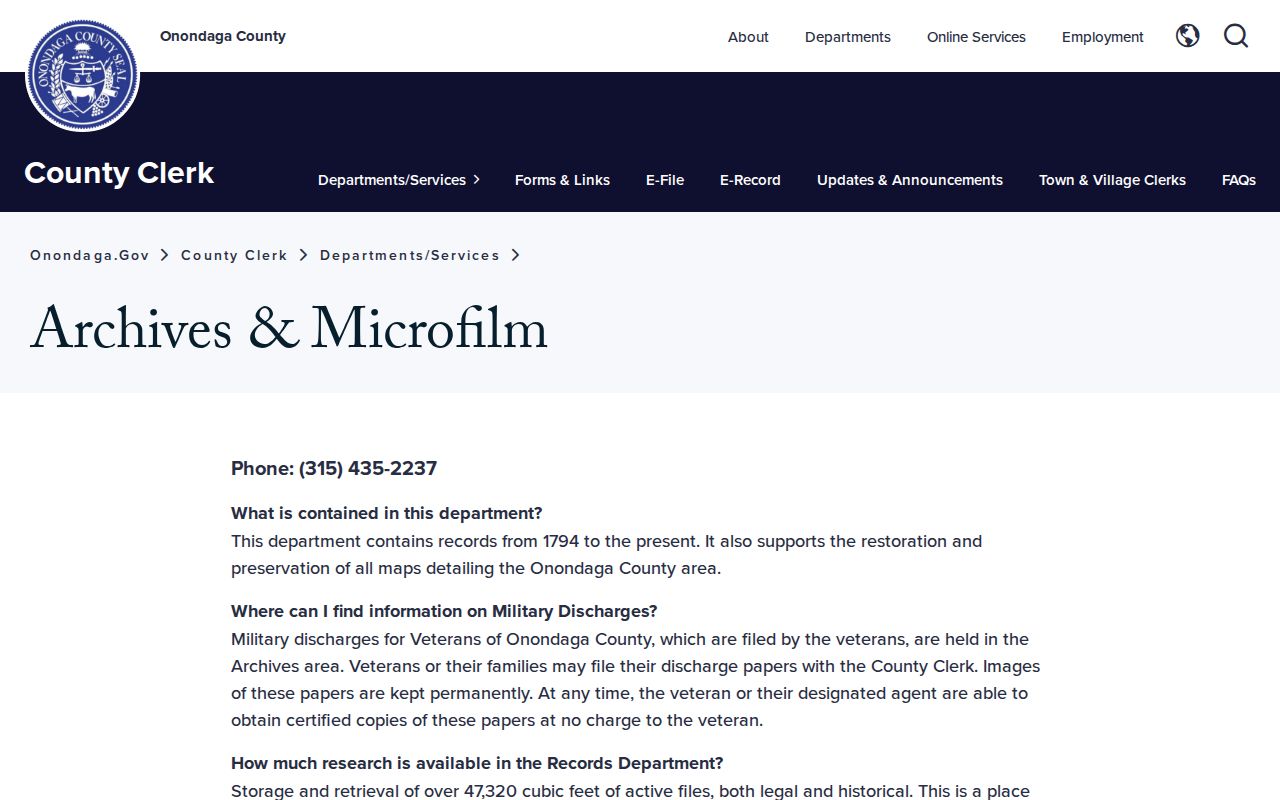
The archive image is a reminder to request the exact directory year and to expect older supporting material in archival formats rather than as a uniform online index.
Onondaga County City Directory Film at NYSL
The New York State Library city-directory list is especially useful for confirming the early Syracuse holdings. It identifies 1844 and the 1851/52, 1853-55/56, and 1857-59/60 directories on fiche, followed by 1861-1935 on film. The same holdings note selected Syracuse telephone books from 1900 through 1950/51. This specificity matters because a search for a precise year can fail simply because the volume is on a different medium or held at another repository.
The state-library holdings page documents the Syracuse directory and telephone-book coverage.
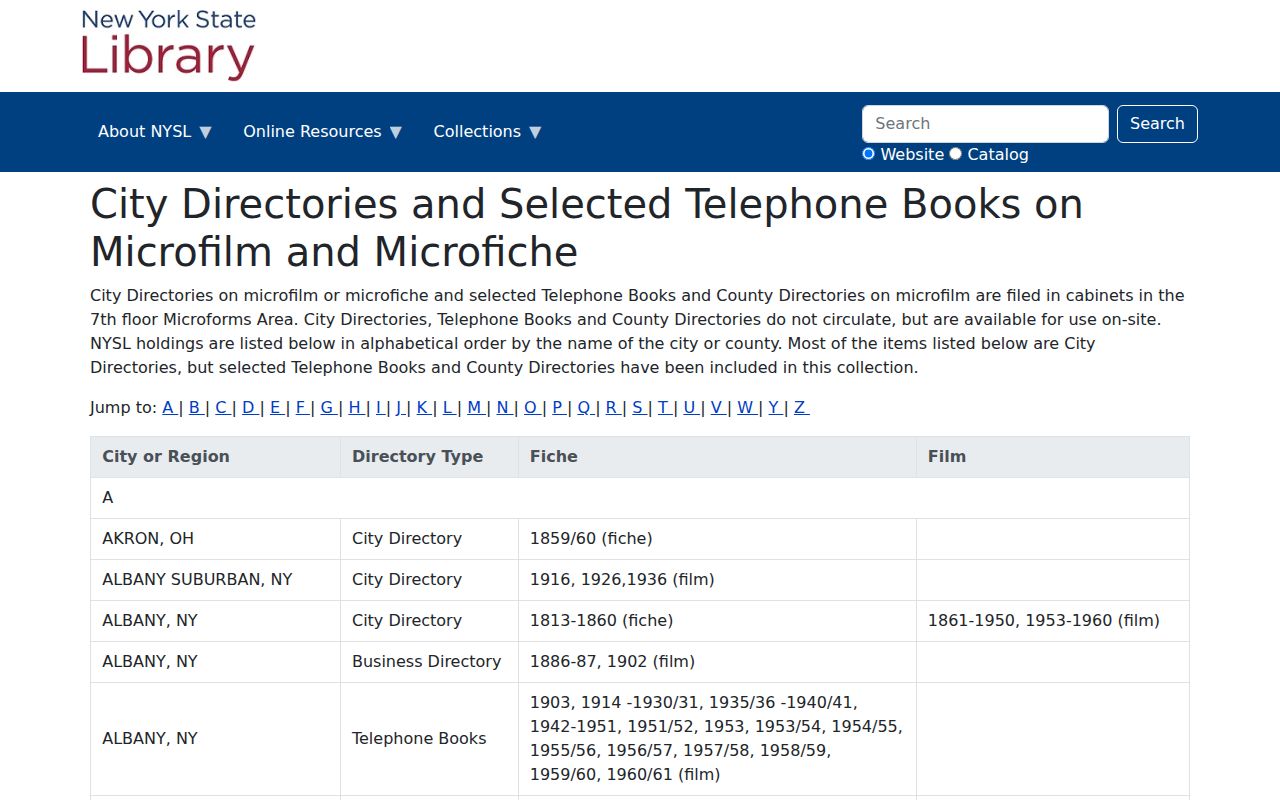
Use the state list to target a date and format, then confirm access procedures with the holding library before travel.
For 1894-1895, FamilySearch catalogs Boyd's Syracuse Directory. It is a catalog lead, not an assurance of open downloading: digital viewing can depend on a FamilySearch account, affiliate access, or copyright permissions.
How Onondaga County City Directory Entries Read
An entry normally pairs a name with an address and occupation. Later Syracuse volumes may also offer spouse, employer, church, or school clues. Read each mark in the actual volume instead of assuming that a shorthand sign has one meaning in every year. The entry gives the publisher's reported information at that moment. It does not settle a current address or establish a family relationship by itself.
| Name | Record the spelling, initials, and any alternate form printed in the volume. |
|---|---|
| Address | Copy the house number and street exactly, then compare it with nearby years. |
| Occupation | Use it as a distinguishing clue when several people share a name. |
| Spouse or household clue | Record a spouse, household reference, church, school, or employer clue only as printed. |
| Year and page | Capture the directory title, volume year, page, and repository call number. |
- Criss-cross directory
- An address-ordered part of a directory, useful for seeing entries associated with a street rather than starting with a surname.
- Householder index
- A list organized around the household or address that can help reconnect an address to a named entry.
- Abbreviation key
- The volume's own explanation of shortened terms and marks. Check it before expanding a notation in notes.
Search the same surname under initials and likely alternate spellings, then use the printed address and occupation to separate people with similar names. Check the years on both sides of a promising entry. The research collection advises capturing the volume title, year, page, entry text, and repository call number, which makes the finding reproducible when a later source disagrees.
OHA Records for Onondaga Addresses
The Onondaga Historical Association's Wright Research Center adds family-name files, photographs, maps, and location files to a city-directory trail. Its holdings include more than one million two-dimensional documents, with maps and atlases, architectural drawings, business and industry material, photographs, and military and civilian records. Search the New York State Library Catalog using library code HDI and the phrase “Onondaga Historical Association” to approach the partial catalog.
The OHA Research Center gives the current access notice.
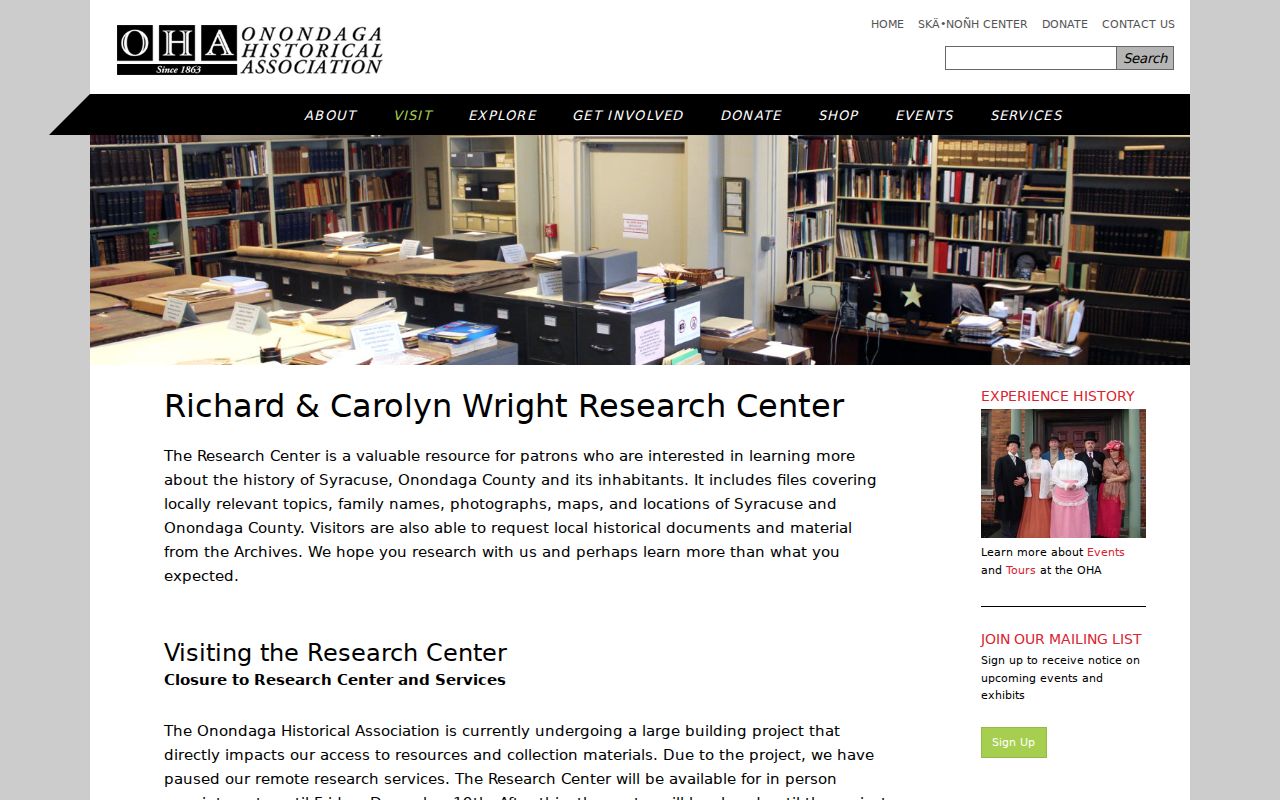
OHA says its major building project has paused remote services, while in-person appointments are available through December 19; the stated completion expectation is summer or fall 2026. Its address is 321 Montgomery Street, Syracuse, and the phone is 315-428-1864.
Research limitation: the supplied research does not document OHA's routine reading-room hours. Confirm appointment availability and hours before visiting.
Tracing Onondaga City Directory Households
Start with the first directory year that plausibly names the household. Follow the surname forward and backward, recording address changes, spelling shifts, occupation, and any household clue. Then check the address-oriented portion when a criss-cross or householder index is available. Pair the resulting dates with census records rather than assuming every person at an address was related. The 1950 federal census is the latest released decennial census; OCPL also holds federal census rolls for New York and nearby states for 1790-1880 and 1900-1930, with stated exceptions.
- Find the surname, initials, and address in a selected directory year.
- Copy the title, year, page, entry, and repository before moving to another volume.
- Search adjacent years for a move, name variant, or change in the household listing.
- Use the address-ordered portion if available, then note nearby entries as context rather than proof of a relationship.
- Match the directory date to the nearest census, recording the census year, enumeration district, page, and address evidence separately.
A disappearance can mean a move, death, omission, or changed spelling. Newspapers, an obituary, a deed, and a census are useful checks because they answer different questions. For a current parcel or address-record chain, use the street directory rather than stretching historical volumes into a present-day source.
Onondaga City Directory Access Routes
Choose the access route to fit the date and the question. A local visit to OCPL is the direct route to its print, fiche, microfilm, telephone, newspaper, and genealogy resources. The Clerk Archives is the stronger companion when a Syracuse directory needs a county census, map, naturalization, or older archival record. The New York State Library holdings list helps locate an early Syracuse volume on fiche or film. OHA is the route for its location files, maps, photographs, and family-name material, but its current building project makes an appointment and service-status check essential.
Remote access is narrower. FamilySearch can lead to Boyd's 1894-1895 directory record, subject to its viewing conditions. OCPL's genealogy query guidelines describe how to request a targeted staff search rather than a broad name hunt. Give name variants, date range, street or municipality, occupation, and the precise point to confirm. A catalog entry, an OCR hit, or a staff response is a lead that should be tied back to a volume year and page whenever possible.
The New York Genealogical and Biographical Society's Onondaga collection is another online discovery channel for OCR-searchable county histories, early-settler accounts, biographies, county officers, and directories. OCR can misread names and addresses, so inspect the page image before taking an entry as a transcription.
Bring a pencil or laptop, exact call numbers if known, and a plan for recording the collection title, reel or volume, page, original wording, and uncertainty. OHA asks researchers to plan for appointment-based access, and the research instructions caution against assuming that unrestricted photographing is allowed. For a library, archive, or request route, verify hours, card rules, appointment requirements, image permissions, and any copy charge just before use.
Onondaga Directory Dates in Context
A short chronology helps keep the formats straight. Syracuse's first known directory is 1844. The early OCPL fiche and state-library holdings reach that start, while the County Clerk Archives begins its Syracuse directory run in 1861. The later OCPL collection shifts from microfilm for 1862-1935 to print for 1936-present. Suburban directories begin in 1957 according to the New York Genealogical and Biographical Society guide.
| 1844 | First Syracuse directory identified by the local research guide. |
|---|---|
| 1861 | Beginning of the County Clerk Archives Syracuse-directory run. |
| 1862-1935 | OCPL microfilm coverage for Syracuse and suburban directories. |
| 1936-present | OCPL print coverage. |
| 1957 | Beginning of suburban directories noted by the NYG&B guide. |
Note: Recheck collection access and service status before travel because formats and reading-room availability can change.